
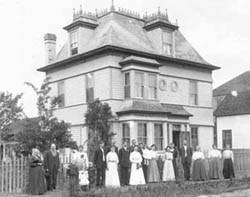
1907 Wedding Portrait of the Pearson Family. Photographer: John T. Wagness
Museum exhibits in the D. O. Pearson House, the Eldridge Center and the Floyd 3rd Floor are open:
- Wednesdays 1 p.m. – 4 p.m.
- Saturdays 1 p.m. – 4 p.m.
- Or by Appointment
The Stanwood Area Historical Society operates the historic house museum known as the D. O. Pearson House, The Floyd Norgaard Cultural Center (a former Oddfellows Hall) and The Dave Eldridge Center (The Eldridge Center was originally known as the Stanwood Camano History Museum built in 1991 behind the Pearson House).
SAHS was incorporated in 1972 and three years later purchased the D. O. Pearson House, the home of the first Mayor of Stanwood. In 2000 the former I. O. O. F (Oddfellows) Hall (now the Floyd) and Tolin House were purchased and by late 2000 we began fundraising for major rehabilitation and additions to these buildings. We have grown and now have an ambitious schedule of activities and many new projects in the Dave Eldridge Center and in the Floyd Norgaard Cultural Center.
Please consider joining us to be part of this growing and active heritage organization! (see our mission statement below)
For tours or more information, contact us
Look for us in the Tolin House (Business office) or try the Dave Eldridge Center 2nd floor.
(If no one is there, you may try the Eldridge Center/Museum 2nd floor for volunteers working on projects.)

We are located on the corner of 102nd Ave and 271st in the west end of Stanwood. We do take history or business questions by phone or email.
MAILING ADDRESS:
Stanwood Area Historical Society
P.O.Box 69
Stanwood,WA 98292
There is no charge for admission but donations are welcome.
The Stanwood Area Historical Society is a 501c3 non-profit organization, charitable donations are deductible.
Volunteers are welcome ! call 360-629-6110
The building addresses are
- D O Pearson House 27108 102nd Ave NW
- Dave Eldridge Center (behind Pearson House) which has photographic exhibits and a research area.
- Tolin Office 27112 102nd Ave NW.
- Floyd Norgaard Cultural Center: 27130 102nd Ave NW.
- Camwood Genealogy Workshop are normally held at the Eldridge Center unless otherwise directed at the door.
- Stanwood Camano Historic Sites Tour
You may use the parking lot behind the Centers or street parking.
STANWOOD AREA HISTORICAL SOCIETY
MISSION STATEMENT:
The Stanwood Area Historical Society seeks to discover, preserve, and display any materials which help to establish, illustrate, and interpret the economic, social, and cultural heritage of the greater Stanwood area, including if financially possible and appropriate, historic sites and properties.
~~~~~~~